Appointment Booking: Managing Meeting Requests in My Schedule
Meeting requests in Vault CRM can be generated through multiple channels:
- HCP-Initiated Requests - HCPs submit meeting requests via Engage. See Appointment Booking for HCPs for more information.
- Approved Email Responses - HCPs respond to meeting invitations sent through Approved Email. See Appointment Booking: Sending Meeting Requests via Approved Email for more information.
- Data-Loaded Requests - Meeting request (meeting_request__v) records are imported into Vault CRM via data loading
When CRM users receive a meeting request, they can conveniently accept or decline it directly within My Schedule, streamlining the scheduling process and ensuring engagement with HCPs.
When CRM users receive a meeting request, they can accept or decline it directly within My Schedule, streamlining the scheduling process with HCPs.
Meeting requests in Vault CRM can be generated from HCP requests in the appointment booking site or from data loading Meeting Request (meeting_request__v) records. See Appointment Booking for HCPs and Data Loading Meeting Request Records for more information.
Who can use this feature?
- Business Admin Users - Browser
- Data load meeting requests
- End Users - Browser, iPad
- Manage meeting requests
- Users require an Engage license
Configuring Managing Meeting Requests in My Schedule for
 End Users
To configure this feature:
- Ensure Appointment Booking: Sending Meeting Requests via Approved Email is configured.
- Navigate to Admin > Users & Groups > Security Profiles.
-
Assign the Engage End User Permission Set to the appropriate security profiles, which includes:
Object Object Permission Object Types Fields Field Permission call2__v
CRE
n/a
- account__v
- call_channel__v
- duration__v
- meeting_request__v
- owner__v
- phone__v
- status__v
Edit
engage_link_settings__v R n/a - application_profile__v
- security_profile__v
Read meeting_request__v
RE
n/a
- account__v
- call2__v
- decline_reason__v
- engage_notification_id__v
- invitee_email__v
- invitee_locale__v
- invitee_time_zone__v
- is_hidden__v
- meeting_request_status__v
- status__v
- status_last_modified_datetime__v
Edit
- assignee__v
- duration__v
- external_id__v
- invitee_display_name__v
- meeting_type__v
- phone__v
- start_datetime__v
Read
- Navigate to Admin > Configuration > Objects > meeting_request__v > Object Types > Edit Object Type Fields.
- Ensure the picklist values for the following fields on the meeting_request__v object are active for the engage_scheduling_site__v object type:
- meeting_request_status__v
- requested__v
- accepted__v
- declined__v
- reschedule_requested__v
- decline_reason__v
- invitee_canceled__v
- rescheduled_offline__v
- unknown_invitee__v
- schedule_conflict__v
- no_reason_provided__v
- Navigate to Business Admin > Objects > VMobile Object Configurations.
- Activate the appropriate VMOCs for the meeting_request__v object.
Do not add the Meeting Requests related list to layouts on the account__v object to prevent end users from editing meeting_request__v records.
Optional Configuration
Admins can disable the ability for users to skip the selection of a reason for declining a meeting request. To do this, remove the no_reason_provided__v picklist value from the list of available values on the decline_reason__v field for the appropriate meeting_request__v object type.
Customers can define an optional company logo to display in the confirmation email sent to HCPs after end users accept a meeting request. To do this, populate the company_logo__v field on the appropriate Engage Link Settings record with an externally hosted URL to the appropriate image.
Customers can define an optional company name to display in the subject line of the confirmation email sent to HCPs after end users accept a meeting request. To do this, populate the external_company_name__v field on the appropriate Engage Link Settings record with the appropriate company name.
This feature uses the Engage System User in place of a traditional integration user. System Users are created in Vault CRM instances and managed by Veeva for integration purposes. By default, these users are assigned the appropriate permission set with all necessary permissions. Customers cannot update the permission set.
For customers who use profile-specific Engage Settings records and want to configure the company logo and company name, ensure there is an Engage Settings record for the System User Application Profile. See Application Profiles for more information.
Data Loading Meeting Requests as
Business Admin Users
Meeting requests can be added to Vault CRM via the data loader, rather than via the appointment booking site. This enables meeting requests made in external systems to be added and responded to in CRM. See Creating, Updating & Deleting Object Records Using Vault Loader for more information about data loading.
The following fields are required when data loading meeting_request__v records:
- object_type__v – Must be a custom meeting_request__v object type. It is recommended that the name of the custom object type reflect the source of the meeting request. Do not use the engage_scheduling_site__v object type.
- assignee__v – The user the HCP is requesting to meet
- duration__v - The meeting duration. The default value is 30.
- invitee_display_name__v – The formatted_name__v field of the HCP account
- start_datetime__v – The date and time requested
- status__v – requested__v
The following fields are optional, but enable users to easily respond to meeting requests in My Schedule:
- account__v – The originator of the meeting request. If an account is not specified, the user selects an account when accepting the meeting request.
- invitee_email__v - The HCP’s email address. A confirmation email is sent to this email address when the user accepts the meeting request.
- meeting_type__v – The HCP’s selected meeting type. This corresponds to the call channel for the call created from the accepted meeting request. The meeting type may be one of the following values:
- In-Person
- Video
- Phone
- Chat or text
- Other
Receiving Meeting Request Notifications as
End Users
When an HCP requests a meeting using the appointment booking site, a meeting request record is created in Vault CRM.
In addition to the created meeting request record, end users receive an email from scheduling@veevacrm.com stating an HCP requested a meeting, along with a prompt to respond and schedule the meeting as soon as possible.
For example, when an HCP requests an In-Person meeting with you, you receive the following email:

Managing Meeting Requests in My Schedule as
End Users
Meeting requests display to end users in My Schedule. See the following sections for details on managing meeting requests as an end user:
- Viewing Meeting Requests
- Accepting Meeting Requests
- Declining Meeting Requests
- Removing Meeting Requests from My Schedule
- Managing Rescheduled Meeting Requests
- Automatically Sending Confirmation Emails for Accepted Meeting Requests
Viewing Meeting Requests
Meeting requests display in users' My Schedule calendars:
- On the iPad platform, meeting requests display in Week, Agenda, and Map Views; they do not display in Scheduler View
- On the Browser platform, meeting requests display in all My Schedule views
If the meeting request has a meeting type, it displays in the meeting request’s header.
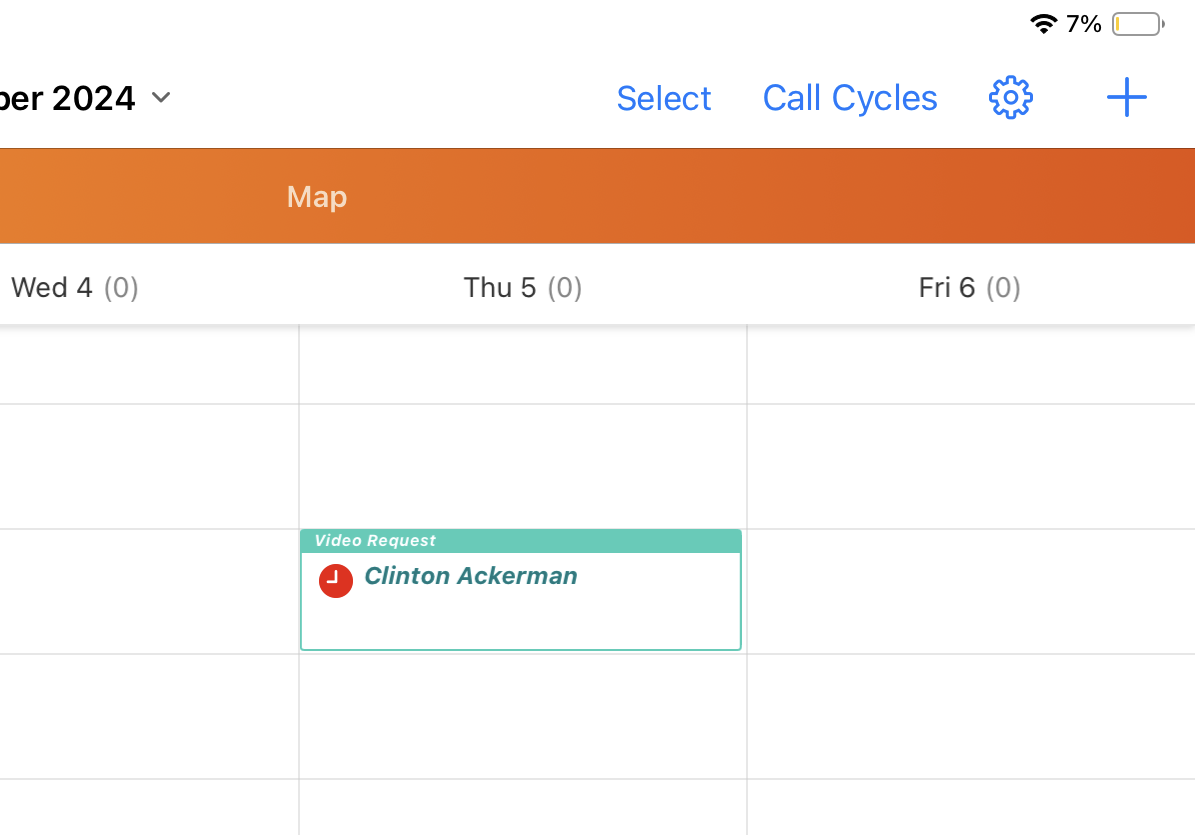
Meeting requests not accepted or declined display with a red clock icon to indicate action is required.
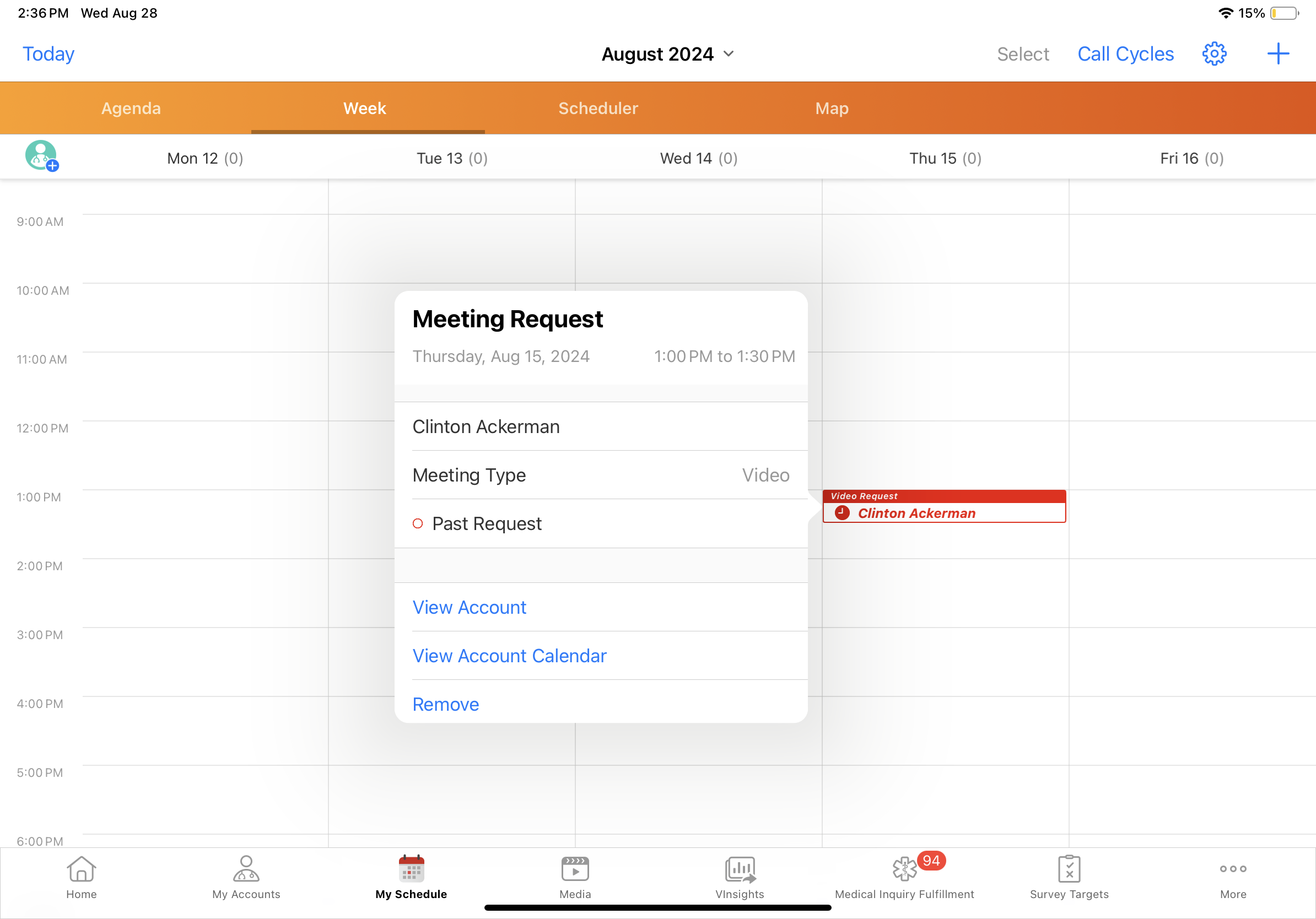
If the requested time and date is in the past, meeting requests display in red.
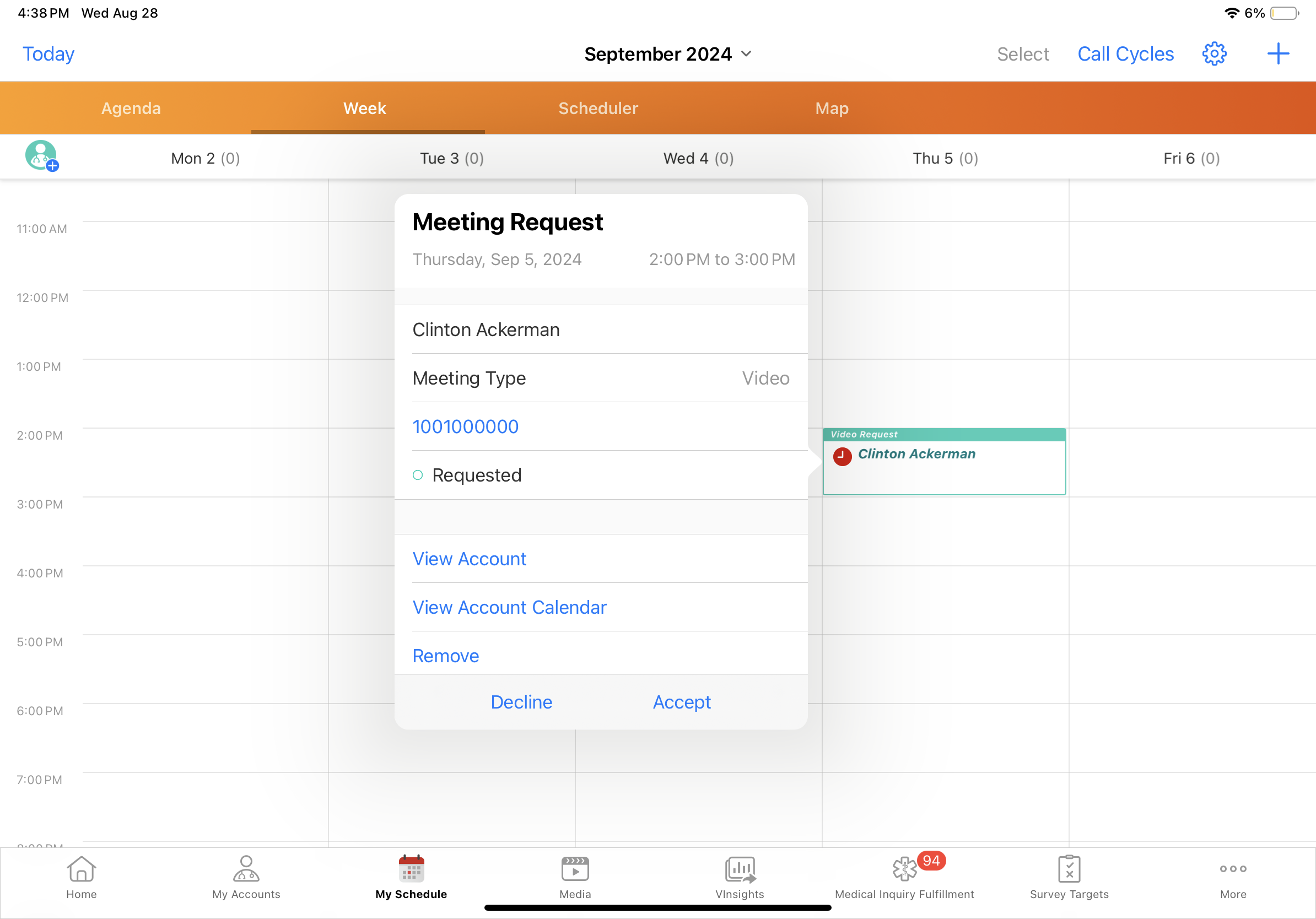
Select a meeting request to display the details. After reviewing the meeting request’s time and date, the user can decide to accept, decline, or remove the request.
Accepting Meeting Requests
When a meeting request is accepted, a call report is created referencing the meeting request. Key values from the meeting request, for example the Account and Start Date and Time values, are transferred to the call report. The Call Channel is automatically populated based on the meeting type the HCP selects on the appointment booking site.
Additionally, a confirmation email is sent to either the email address associated with the HCP’s Engage profile specified on the meeting request record, or the invitee email address on the meeting request. The email address used for confirmation emails is determined by the method used to create the meeting request:
The email address used for confirmation emails is determined by the method used to create the meeting request:
- If the Engage entry point for appointment booking is enabled, the confirmation email is sent to the email address associated with the Engage Profile ID of the HCP who submitted the meeting request
- If using Appointment Booking: Sending Meeting Requests via Approved Email, the confirmation email is sent to the email address of the HCP who submitted the meeting request
- If the meeting request was data loaded or manually created, the confirmation email is sent to the Invitee Email on the meeting request record, if populated
Users cannot accept meeting requests for accounts where they are restricted from making calls. For example, users cannot accept meeting requests from an account where Restricting Calls by Account is enabled, or an account without any allowed object types when Restricting Calls by Account Object Type is enabled. A warning displays in the meeting request popover if the associated account has a call restriction.
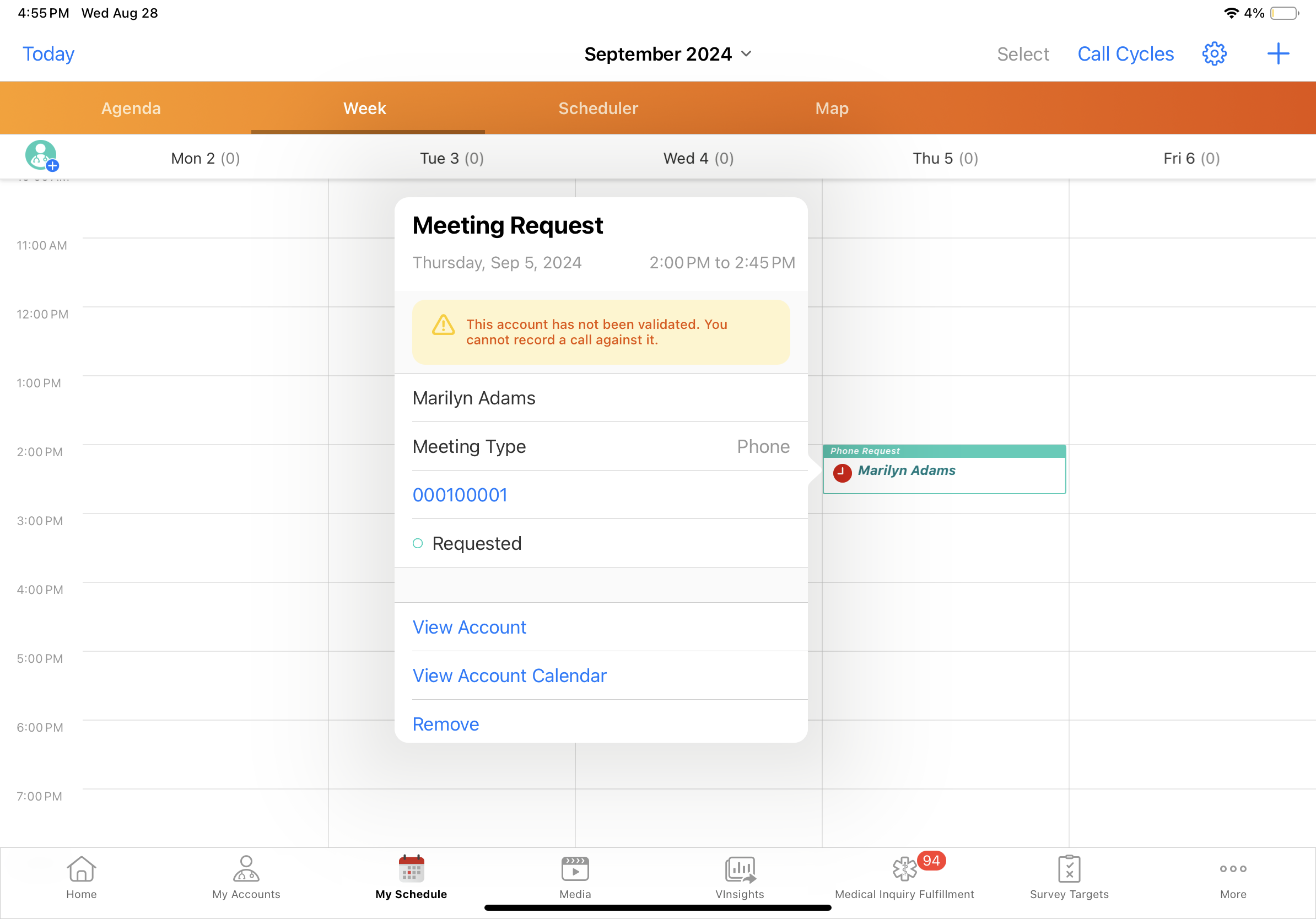
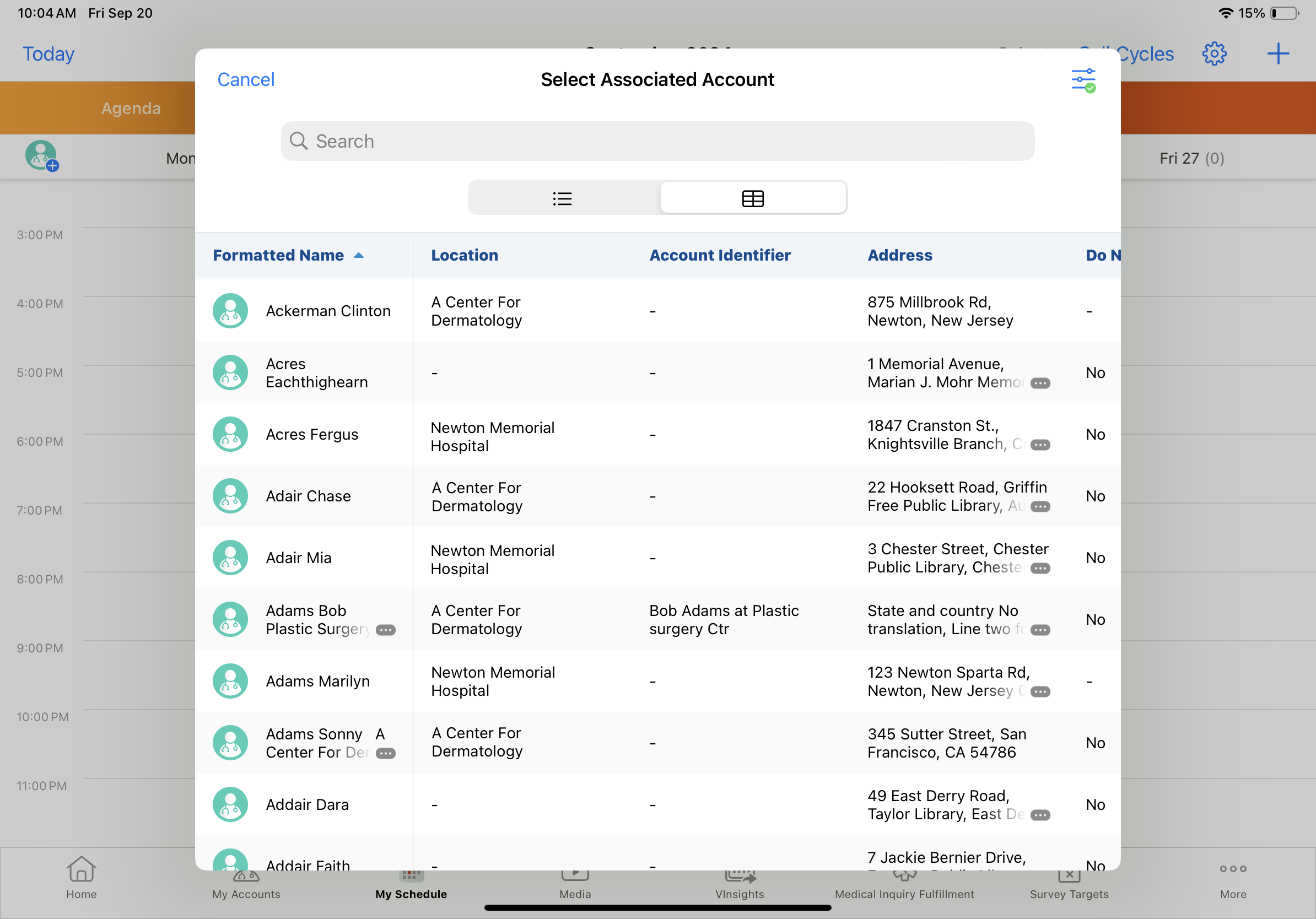
Meeting requests created from the appointment booking site or by data loading may not have an associated account. If the user accepts a meeting request without an associated account, the user must search for an account to populate on the call.
Declining Meeting Requests
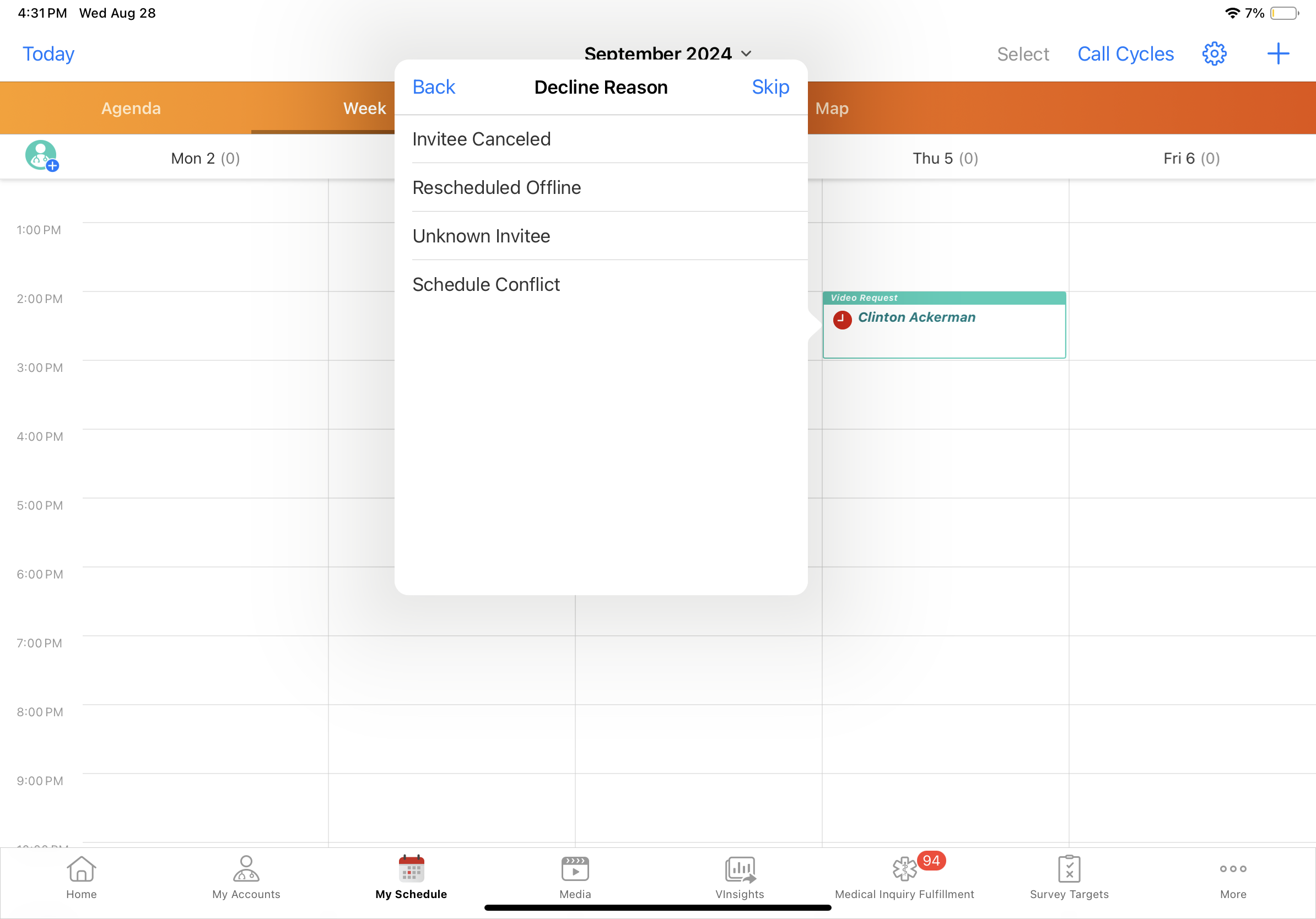
To decline a meeting request from the meeting request popover in My Schedule:
- Select Decline.
-
Select the appropriate reason for declining the request. This step is optional and can be skipped by selecting Skip.
When users decline a meeting request, an email is not automatically sent to the HCP. To schedule a meeting at a different time, users can send an Approved Email invite to the HCP or reach out to the HCP through another channel.
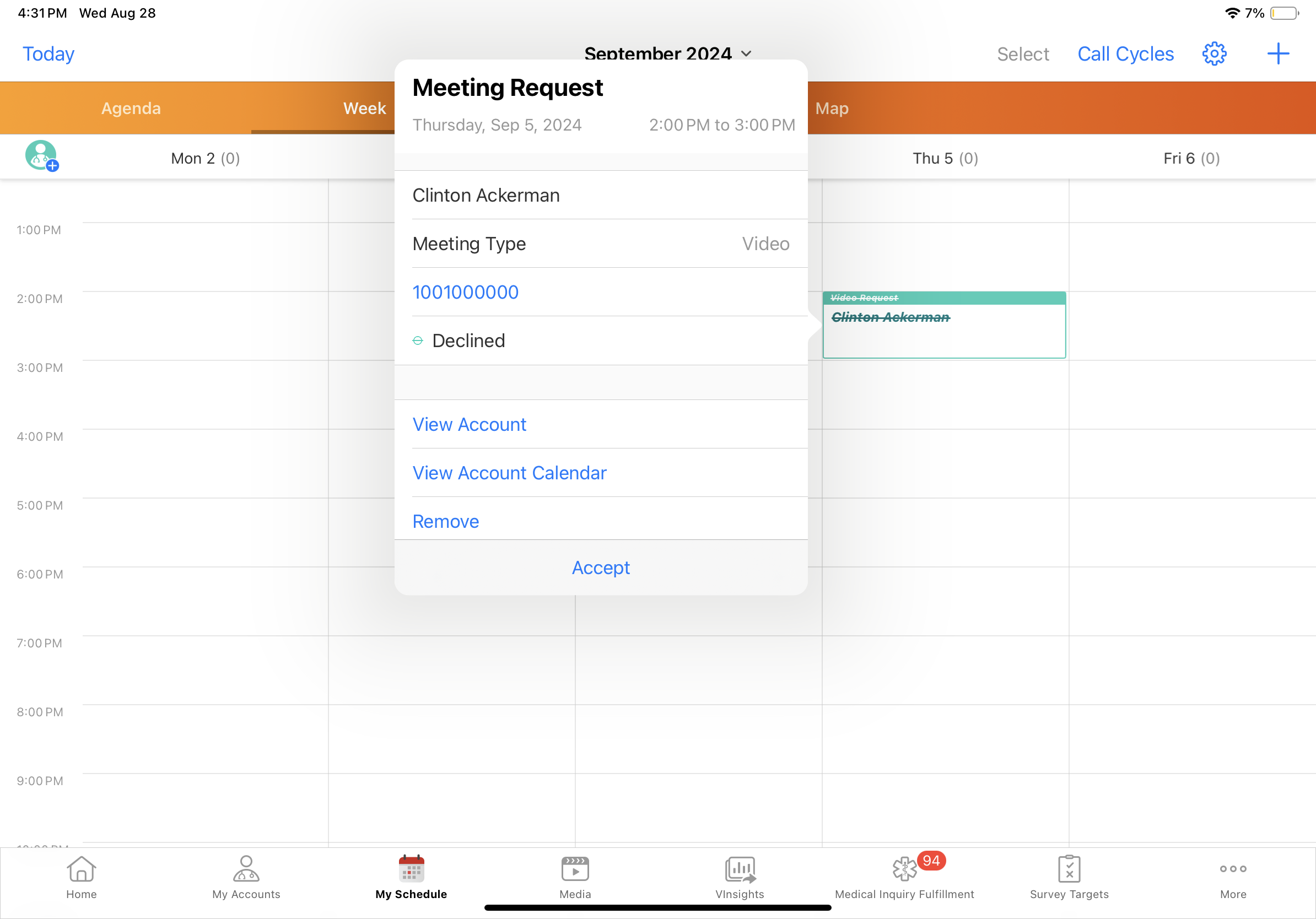
Users can also select and accept a declined meeting request.
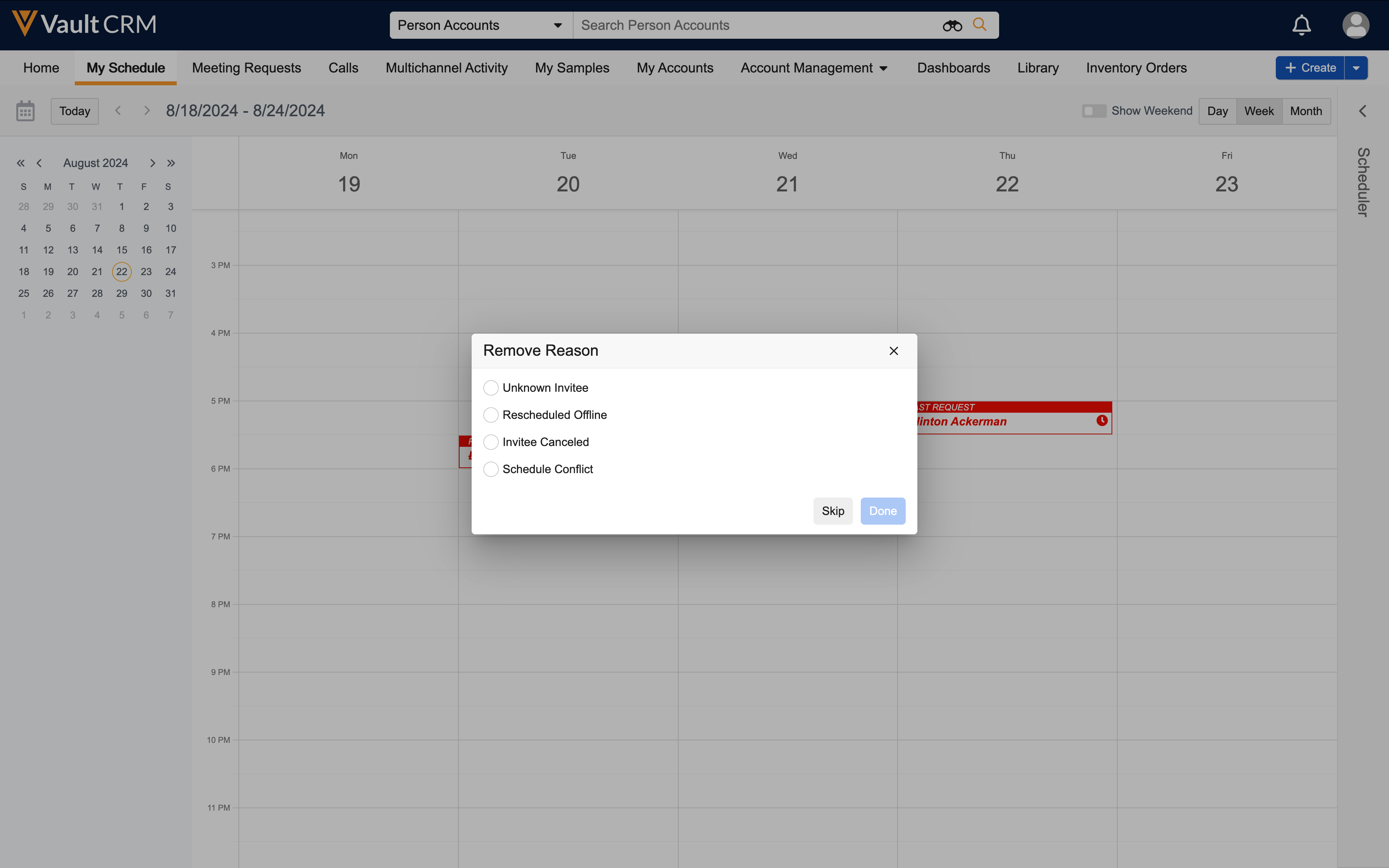
Removing Meeting Requests from My Schedule
Users can remove declined or requested meeting requests from their schedule:
- Select the Remove button.
-
Select the appropriate reason for the removal.
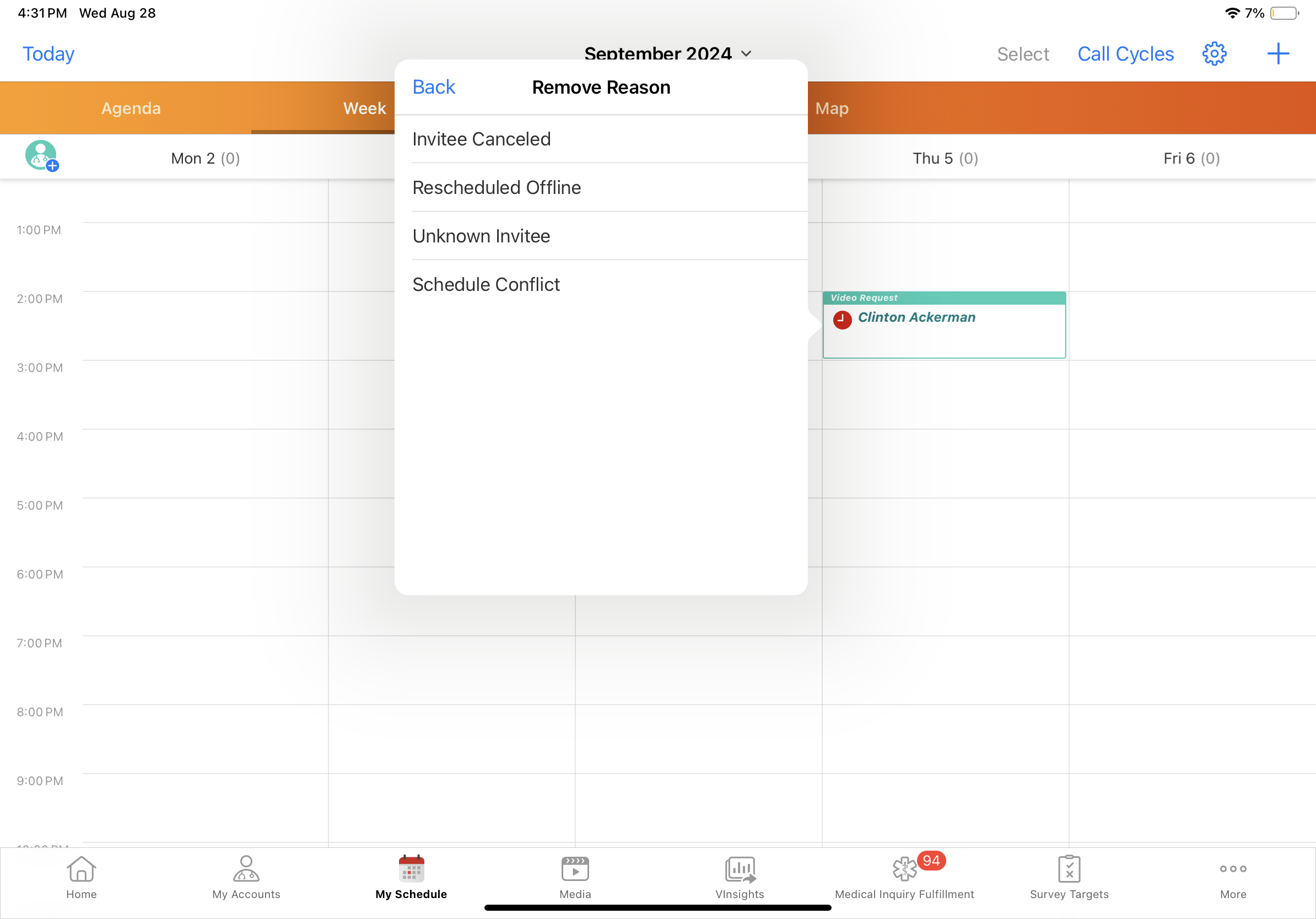
On the Browser platform, this step is optional and can be skipped by selecting Skip.
Managing Rescheduled Meeting Requests
When a meeting request is rescheduled, a new meeting request displays in My Schedule. End users can respond to the rescheduled meeting request via the Accept and Decline buttons.
When a user accepts a rescheduled meeting request, a new call report is created. Additionally, depending on the status of the original request, one of the following occurs:
- If the user did not respond to the original request, the status of the meeting request is updated to Reschedule Requested and the request is removed from My Schedule
- If the user accepted the original request and a call report was created, the call report displays a banner indicating the call is rescheduled
Automatically Sending Confirmation Emails for Accepted Meeting Requests
To notify HCPs about accepted meeting requests, confirmation emails are automatically sent to HCPs when a user accepts a meeting request in My Schedule.
Accepting a meeting request that was previously declined does not automatically send the confirmation email.
When a user accepts a meeting request in My Schedule, a confirmation email is sent to the account based on the Invitee Email on the corresponding meeting request record. This email details the meeting type, date and time, and participants.

This email is supported in all of Vault CRM’s supported languages and uses the Invitee Locale from the corresponding meeting request to determine the language of the email.
Additionally, the Add to Calendar link displays in the email, allowing the HCP to download the .ICS file and add the scheduled meeting to their calendar.