Searching the Media Library
- Document Model
Two types of search are available in the CLM media library to help end users efficiently locate presentations: standard search and advanced text search. Standard search allows end users to find presentations by entering all or part of the title. The search results display by relevance. For a more granular approach, advanced text search allows end users to find presentations by searching for specific text within the slides and navigating directly to the relevant content.
Users can apply filters to both standard search and advanced text search results. This allows users with large media libraries to quickly find presentations by narrowing long lists of search results.
Who can use this feature?
- End Users - iPad, iPhone
- Using standard search
- Using advanced text search
- Users do not require an additional license
Configuring Standard Search for
 All Users
To configure this feature, ensure Configuring CLM as Document Model is complete.
Configuring Advanced Text Search for
Business Admin Users
To configure this feature:
- Ensure Configuring CLM as Document Model is complete.
- Navigate to Business Admin > Objects > Multichannel Settings > Global Multichannel Settings.
- Enter 1 for the clm_content_search__v Multichannel Setting.
This setting is enabled as a Vault-wide setting and cannot be enabled for specific profiles.
- Enable multilingual document handling. See Vault Help for more information about supported OCR languages.
End Users
To configure this feature, ensure Configuring CLM as Document Model is complete.
To allow end users to search using languages other than English:
- Navigate to Admin > Users & Groups.
- Select the appropriate user.
- Select Search Preferences in the right panel.
- Select Edit Languages in the Search Preferences section.
- Add the appropriate languages to the Document Search Languages field.
- Select Save.
Using Standard Search as
End Users
To search the media library, navigate to the Media tab, select the search bar, and enter the appropriate search terms. Search terms are searched against the following document fields:
- Name
- Title
- Searchable Keywords
- Detail Product
Search results display exact matches to the search terms first, then results containing all the search terms (AND), and finally results containing any of the search terms (OR). Only presentation names and thumbnails display in the search results. Descriptions and keywords do not display and search terms are not highlighted.
To apply filters to the search results, select the filter icon and select the appropriate filters. See Using Presentation Attributes to Filter Presentations for more information about configuring and using filters.
Using Advanced Text Search as
End Users
Advanced text search uses Vault document search on the viewable renditions of Slide documents in CLM Presentation binders. See Vault Help for more information on how Vault document search works.
Only approved content is available in advanced text search results. The following CLM content types are supported:
- PowerPoint - Text in images in PowerPoint presentations is not supported
- PDF - Protected PDF renditions in PromoMats/MedComms are not supported
- HTML
When manually uploading a distribution package for HTML content, ensure a high resolution (more than 300 DPI) poster.png image is included in the package. This allows HTML content to display in advanced text search results. See Manually Uploaded Distribution Packages for more information.
- Images
Users can select the search icon to display the search screen and select the Advanced Text Search tab.
Advanced text search is not a type-ahead search. Users must enter the search terms and select Search or select the Enter key to start the search. A list of presentation slides displays in the search results, restricted by the user’s visibility to the presentations in the media library. When searching for presentations during a call, restricted products, allowed products, and segmentations are all respected and only display what is available for the account.
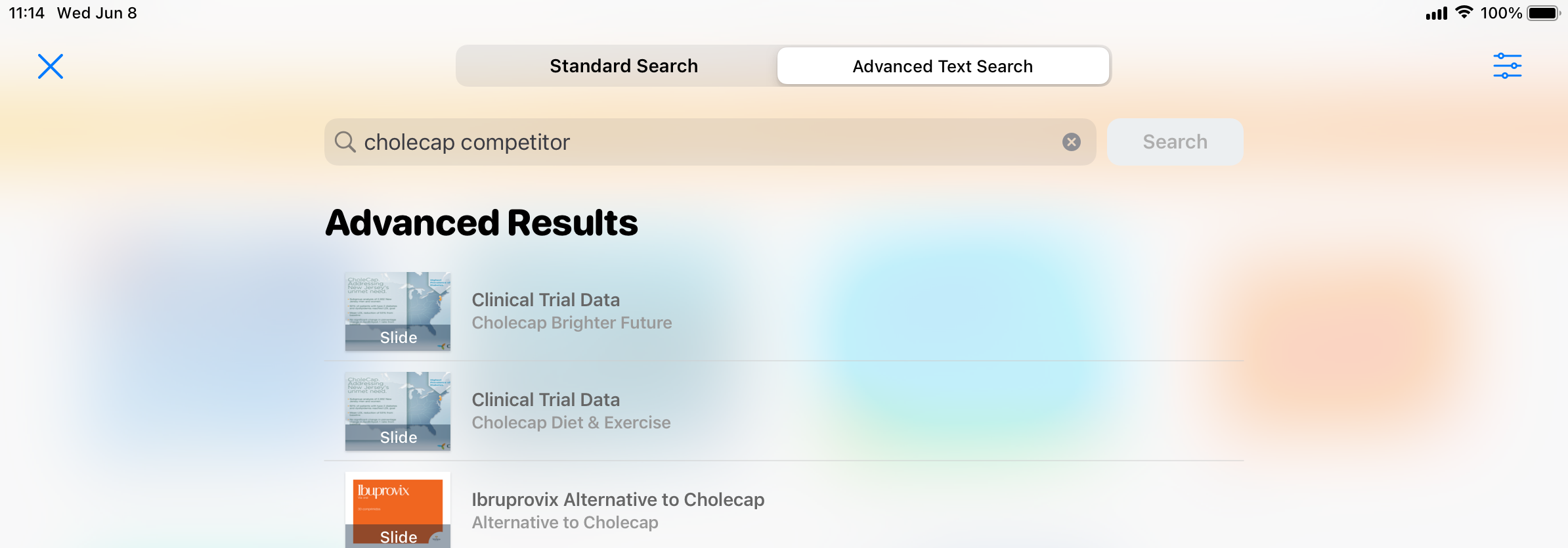
To apply filters to the search results, select the filter icon and select the appropriate filters. See Using Presentation Attributes to Filter Presentations for more information about configuring and using filters.
Considerations
- The scope of CLM search includes HQ (read-only) and custom presentations. Training Presentations are not included in the scope of the search.
- On the iPad platform, if a user is in a directory or applies a label and performs a search, the results are not confined to presentations in that directory
- To correctly process CLM content for advanced text search, ensure the content satisfies the following conditions:
- The recommended resolution for images is 300 DPI
- Use a moderate brightness level for images. A very high or very low brightness level decreases how accurately Vault CRM processes text embedded in an image.
- The recommended font size is 12pt or larger
- Ensure font faces and sizes are consistent throughout a document
- Ensure scans of physical content pages are not skewed
- Ensure documents have a high contrast between the text color and the background color
- Users must have an active internet connection to use advanced text search
- As best practice to return the most relevant and specific search results with advanced text search, users with large media libraries should include multiple words in their search terms
- When using advanced text search to search for a phrase in Chinese, Japanese, or Korean, users must enter more than one character in the search terms
- When using advanced text search, emojis larger than 4 bytes cannot be searched
- Search results and filters do not reset when navigating between standard search and advanced text search